





What a good autism planner does
Many autistic children and adults find a day easier to manage when they know what is coming. Not every detail, but the main things: what is happening now, what comes next and when the change will happen. A good autism planner answers those questions before anyone has to ask them.
In practice, that means a planner that is:
- Visual: a picture for each activity, so the plan does not depend on spoken words that are gone the moment they are said
- Predictable: the same pictures, the same order and the same signals every day
- Focused on now and next: the current activity and the one after it, not a wall of information
- Clear about time: a countdown, so "five more minutes" is something you can see
- Fair about transitions: a heads-up before a change, so the switch does not come out of nowhere
- With the person: at school, in the car or at the pool, not only on the kitchen wall
A paper schedule does much of this well. Where it falls short is time and place: a chart on the wall cannot count down or give a signal, and it stays at home.
How the GentleTime autism day planner works
- Plan the day in pictograms. On the web or in the phone app, a parent or carer drags pictograms onto a timeline and sets how long each activity lasts. There are about 3,000 pictograms in 20 color-coded categories, and you can add your own pictures, such as a photo of the school. A full day takes a few minutes.
- Save the days that repeat. Save a school day or a Saturday as a template, or copy yesterday and change what is different.
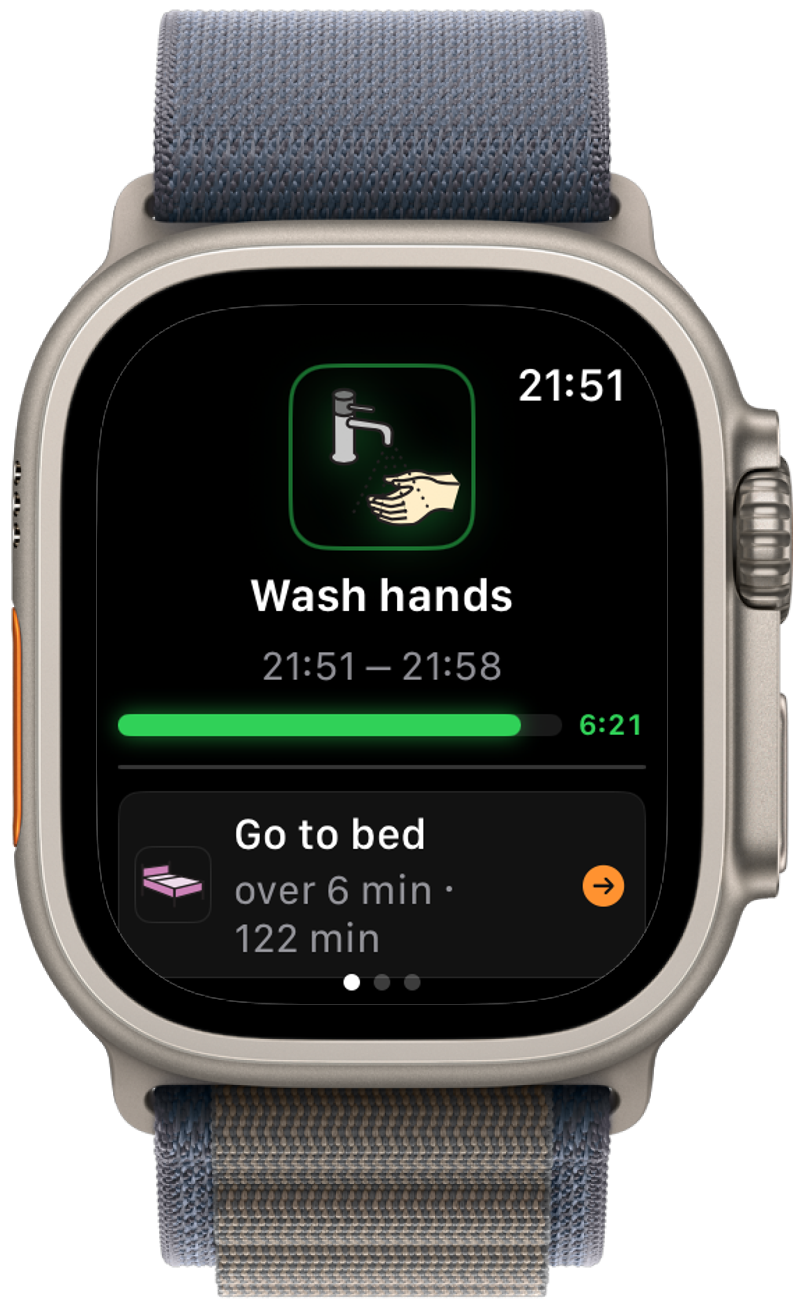
- Follow it on the wrist. The schedule syncs to an Apple Watch or Wear OS watch. The watch shows a picture of what is happening now, a countdown and what comes next. At each transition it gives a gentle vibration, with an optional heads-up before the change. Once synced, it keeps working offline, so no phone needs to be nearby.
- Or follow it on a phone. No watch? The person can follow the same day in the GentleTime app on their own phone or tablet, or in the browser with their own simple sign-in. They see what is happening now and what comes next, and tap an activity when it is done.
Only as much as the person can handle
Not everyone does well with a clock. For each person you choose how they follow the day:
| Way of following | What the person sees |
|---|---|
| By the clock | The day moves on by itself at the planned times, with the time left on screen |
| Step by step | The next step comes when they tap Done, so there is no such thing as being late |
| Tick off | A list to tick off in any order, with no times at all |
You also choose whether the watch vibrates, plays a sound or only changes the screen, and whether a heads-up comes before each change. Start with a little and add more when it helps.
An autism planner for children
For children, the planner takes over the reminders a parent repeats all day: brush your teeth, shoes on, time to go. The watch says it with a picture and a vibration, so the child can check their wrist instead of waiting to be told again. Some mornings will still be hard. But when a child can see what is happening and what comes next, many start following more of the routine on their own.
Most families begin with the morning, bedtime or the transitions between activities.
A planner for autistic adults
Adults usually want structure that does not look like a children's chart. A watch is discreet: it looks like any other smartwatch, and there is no chart on the wall. Plans can use pictograms, photos or plain words. The step-by-step and tick-off modes suit adults who find clock times stressful, and each part of the day can be as loose or as detailed as the person wants.
GentleTime also fits supported living and work settings, where a support worker or job coach helps plan the day and the adult follows it independently. Read more in our guide to planning for autistic adults.
For families and care teams
A schedule only works if everyone uses the same one. In GentleTime, both parents, a grandparent, a babysitter or a whole care team work from the same schedule, so the morning runs the same way whoever is on duty. Changes reach the watch automatically.
The person and the people around them can each use GentleTime in their own language: English, Dutch, German, French or Spanish. Care teams get one dashboard that shows how each person's day is going and which transitions are coming up.
Start with the free printable maker
Not sure yet? Make a paper schedule first with the free visual schedule maker: search the pictograms, put them in order and print a strip, a row or cut-out cards, without an account. Many families start on paper and move to the watch when the person is ready to take the schedule with them.
New to visual schedules? Start with how to build an autism daily schedule or a simple now and next board.
Try it free for 14 days
Every plan includes the watch app, the full pictogram library and the schedule builder. You can try everything for 14 days, without a credit card, and then choose a plan for one person, a family or a care team. See pricing and all features.
GentleTime is a planning tool that makes the day visible. It is not a medical device and does not replace support from professionals who know the person.
Frequently asked questions
What is an autism planner?
An autism planner is a visual schedule that shows the day in pictures, in order, so an autistic child or adult can see what is happening now and what comes next. GentleTime adds time and place to that: a countdown, a gentle vibration at each change, and a schedule that goes along on a watch or phone.
Does it work without a smartwatch?
Yes. The person can follow the day in the GentleTime app on their own phone or tablet, or in the browser with their own simple sign-in. They see what is happening now and what comes next, and tap an activity when it is done.
Which watches does GentleTime work with?
Apple Watch and Wear OS smartwatches, such as Samsung Galaxy Watch and Google Pixel Watch. You plan the day on a computer, tablet or phone, and the watch receives the schedule automatically.
Is it for children or adults?
Both. GentleTime works for children, teens and adults who benefit from visual structure. The pictograms are clear and age-neutral, and you choose per person how they follow the day: by the clock, step by step or as a list to tick off.
Can several people manage the same schedule?
Yes. The Family plan includes two caregivers, and the Care Team and Facility plans include unlimited caregivers. Everyone sees the same schedule, so the day runs the same way whoever is on duty.
How much does it cost?
There is a 14-day free trial, no credit card needed. After that, plans start at €7.99 a month for one person, with plans for families and care teams. See pricing for all plans and yearly prices.
Do I need to be good with technology?
No. If you can drag and drop, you can build a schedule. Most parents set up their first day in under 10 minutes, and you can copy a previous day and adjust it.